
Best Coding Interview Prep with Spaced Repetition (2026)
TL;DR
You've solved hundreds of LeetCode problems but can't recall the pattern from two weeks ago. That's because LeetCode gives you a 3,000-item menu and wishes you luck. Firecode's learning engine — the secret sauce behind the platform — serves you real interview problems from real companies at scientifically optimal intervals. 1,500+ problems, adapted to your target employers.
Key Takeaways
- •LeetCode has 3,000+ problems. To master them: 15,000+ solves. Nobody does this. Firecode’s engine makes 173 problems enough.
- •The learning engine is Firecode’s secret sauce: real interview problems from real companies, served based on your targets, skill level, and performance.
- •Median user stats: $127K salary increase, 173 problems solved, just 22 minutes of daily practice.
- •Think Cheesecake Factory menu vs. chef’s tasting menu. One overwhelms you with choice. The other is engineered for results.
- •Our highest user offer? $1.6M total compensation. 15-30 minutes a day for 6 months. No grinding 3,000 problems.
The Interview Prep Paradox
The more problems you solve, the less you actually remember. You grind through 500+ problems over months of preparation. Week 1, you are unstoppable: 20 easy problems done, patterns clicking. By week 8, you have 200+ problems under your belt, but what was that sliding window technique again? Then the interview comes. They ask something you have definitely solved before. Your mind goes blank.
This is not a failure of effort or intelligence. It is how human memory works. Hermann Ebbinghaus documented this in 1885: without strategically timed review, you forget 90% of new information within a week. His forgetting curve shows that memory decays exponentially after initial learning. Every problem you solve without spaced review is time you will need to invest again later.
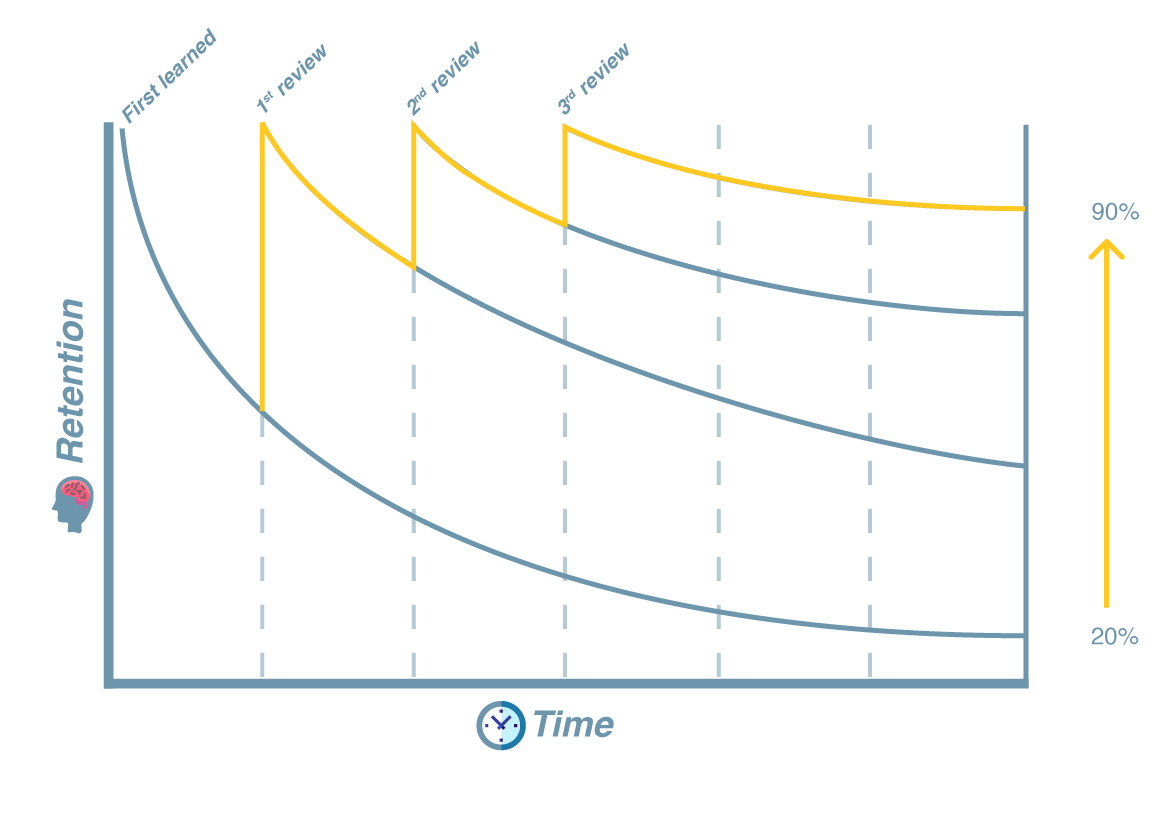
Without review, retention drops to 20%. With spaced repetition, each review flattens the curve and retention stays above 90%.
But each time you successfully recall something at the right moment, the forgetting curve flattens. The memory becomes more durable. This is the core insight behind spaced repetition: time your reviews to coincide with the steepest part of the decay curve, and you can maintain 90%+ retention with minimal effort.
How Firecode's SM2-Boosted Learning Engine Works
The learning engine is the reason Firecode works. It is not a problem bank with flashcard scheduling bolted on. It is a purpose-built engine that draws from 1,500+ real interview problems asked at real companies — Google, Amazon, Meta, and dozens more — and serves them based on your target employers, your skill level, and your performance. Built on SM-2 (Piotr Wozniak, 1987) and enhanced with ML models tuned for coding interviews.
Every time you solve a problem, the engine analyzes real signals from your performance: the code you write, how long you take, whether your solution passes all test cases, and how your performance compares to previous attempts. It uses these signals to calculate the optimal time to resurface each problem. Struggle with a problem and it comes back within a day. Ace it and the interval grows to a week, then two weeks, then a month.
When you first sign up, Firecode runs a calibration sequence to estimate your current skill level across major topic areas: arrays, trees, graphs, dynamic programming, and others. This sets your starting difficulty and review intervals so you are not wasting time on problems that are too easy or drowning in problems that are too hard.
The result: you practice the right problems, at the right time, for the right number of times. No manual planning. No spreadsheets tracking which problems to revisit. The engine handles all of it.
Real Results from Real Engineers
Median salary increase reported by users who landed new roles
Median problems solved before receiving an offer
Median daily practice time. No multi-hour grinding sessions.
Highest offer: $1.6M total compensation. Just 15-30 minutes a day for 6 months using spaced repetition. No grinding 3,000 problems. That is the difference between practicing smart and practicing hard.
Why Spaced Repetition Beats Grinding
Coding interviews test pattern recognition under pressure. You see a problem, identify which technique applies (sliding window, BFS, dynamic programming), recall the approach, and implement it within 30-45 minutes. This is fundamentally a retrieval task: you need to pull the right pattern from memory quickly and accurately.
Grinding creates an illusion of competence. You feel like you know the material because you just saw it. But that feeling fades fast. Three weeks after a cramming session, research suggests you retain less than 30% of what you practiced. When you cram, you rely on recognition (this problem looks familiar) rather than recall (you can reproduce the solution). Interviews require recall.
Spaced repetition forces active recall at each review, building the deeper type of memory you need under interview conditions. By repeatedly recalling solutions at increasing intervals, you build strong, accessible memories of common patterns. When you see a new problem in an interview, you recognize the pattern and apply a well-rehearsed approach.
It is also dramatically more time-efficient. The engine focuses your attention on problems you are about to forget, so you spend zero time re-solving problems you already know well. A typical 22-minute daily session with Firecode covers more ground than 2 hours of unfocused grinding, because every minute is spent on material at the edge of your knowledge.
Spaced Repetition: Platform Comparison
| Feature | Firecode | LeetCode | AlgoExpert |
|---|---|---|---|
| SM2-Boosted Learning Engine | ✓ AI/ML-driven scheduling | ✗ Manual tracking only | ✗ No adaptive system |
| Adaptive Difficulty | ✓ Learns from your code signals | ✗ Self-selected difficulty | ✗ Fixed curriculum |
| Review Scheduling | ✓ Personalized intervals | ✗ No review system | ✗ Manual review |
| Problem Count | 1,500+ curated problems | 3,000+ problems | 160 problems |
| Languages Supported | 13 (all major languages) | ~16 (incl. niche languages) | 9 languages |
| Free Trial | ✓ 14-day free trial | ✓ Many free problems | ✗ Paid only |
| Progress Tracking | ✓ Retention-based metrics | ✓ Completion-based | ✓ Completion-based |
| Company-Tagged Problems | ✓ Tag-based filtering | ✓ Premium feature | ✗ No company tags |
Everything You Need in One Platform
Unlike general-purpose flashcard apps like Anki, which require you to create and maintain your own cards, Firecode provides a complete system: 1,500+ curated problems from real interviews at top tech companies, an integrated code editor, automated test cases, and the SM2-boosted learning engine that picks your next problem automatically.
Firecode supports 13 languages: Java, Python, JavaScript, TypeScript, C++, Go, Scala, Ruby, C#, Rust, Dart, Swift, and PHP. Problems are tagged by topic, difficulty, and company association, so you can focus your preparation on the areas most relevant to your target interviews. The engine works across all these dimensions, ensuring balanced coverage without manual planning.
The platform tracks retention-based progress metrics. Rather than showing a simple completion percentage, Firecode shows you how well you actually remember the problems you have solved. This gives you an honest measure of interview readiness that accounts for memory decay, not just effort invested.
Who Should Use Spaced Repetition for Interview Prep?
Busy Engineers
Working full-time with limited hours for interview prep each week.
- ✓22 minutes a day is all it takes for steady progress
- ✓No wasted effort on already-mastered problems
- ✓The engine handles scheduling so you just show up and code
- ✓Build interconnected knowledge, not isolated solutions
Career Switchers
Learning algorithms for the first time and need to build lasting foundations.
- ✓Calibration quiz sets your starting level automatically
- ✓Gradual difficulty progression prevents overwhelm
- ✓Repeated exposure builds pattern recognition from scratch
- ✓Retention tracking shows real progress, not false confidence
Repeat Interviewers
Have interviewed before but forgot solutions between rounds.
- ✓Solve the exact problem of forgetting between attempts
- ✓Build durable memories that survive weeks-long interview cycles
- ✓The engine focuses reviews on your weakest areas
- ✓Pick up where you left off with preserved progress
Long-Term Planners
Preparing months in advance for a planned job search.
- ✓Compound retention over months of consistent practice
- ✓Cover the full breadth of interview topics systematically
- ✓Daily time decreases as mastery increases
- ✓Arrive at interviews with genuine, tested recall
Frequently Asked Questions
How long does spaced repetition take to show results?
What is the difference between spaced repetition and grinding problems?
How does Firecode's learning engine work?
Can I use Firecode if I only have 2 weeks before my interview?
How many problems should I solve per day?
Is spaced repetition better than doing LeetCode contests?
What programming languages does Firecode support?
How is Firecode different from Anki for coding interview prep?
Does spaced repetition work for system design interviews?
What topics does Firecode cover?
Can I track my interview readiness on Firecode?
Is there a free trial for Firecode?
How does spaced repetition compare to the Blind 75 or NeetCode 150?
What is the science behind spaced repetition?
How do I get started with Firecode?
Stop Grinding. Let the Engine Work.
Real interview problems from real companies. An engine that adapts to your targets and ensures you remember every pattern. 173 problems. 22 min/day. That\u2019s all it takes.
Start Your 2-Week Free Trial